
A security clearance attorney represents federal contractors, military members, government employees and Intelligence Community personnel in adverse-action proceedings affecting access to classified information. The right counsel depends on which procedural track your case sits on: Industry under DCSA and DOHA, MIL/CIV under DCSA, DOHA and PSAB, or Intelligence Community internal adjudication governed by ICD 704.
You opened the envelope, or the email, or the meeting on your calendar that no one would explain. Your clearance is in question. The first thing most people do is search for a security clearance attorney and start clicking through firm websites that all sound the same. The harder question, and the one that controls whether you pick the right counsel, is which procedural track your case is actually on. The answer is buried in the cover letter you just received, and it changes everything that follows.
When You Actually Need a Security Clearance Attorney
Security clearance attorney: an attorney who represents federal contractors, military members, and government personnel in adverse-action proceedings affecting access to classified information, including SOR responses, DOHA hearings, and Intelligence Community appeals.
A security clearance attorney is the right call when one of four documents lands in your inbox: a Statement of Reasons (SOR), a Supplemental Information Request (SIR), a notice of clearance suspension, or an outright denial. Each of these triggers a procedural clock with a fixed response window, and each one changes the leverage you have. Outside of those triggers, what you usually need is a paid SF-86 consultation rather than a full clearance defense lawyer, and the price points are different.
The four trigger documents
Statement of Reasons (SOR): the formal written notice from a federal adjudicating agency that articulates the security concerns supporting a proposed clearance denial or revocation, citing specific Adjudicative Guidelines under 32 CFR § 147 and SEAD 4, and triggering the recipient's response rights.
The four trigger documents are not interchangeable. An SOR (Statement of Reasons) is the formal document explaining why the government is proposing to deny or revoke your security clearance. It contains a list of the specific allegations, facts, and security concerns the government believes raise questions about your eligibility, along with the adjudicative guideline(s) involved. The SOR also gives you an opportunity to respond and present mitigating information before a final decision is made. By contrast, a Supplemental Information Request (SIR) is a request for additional information and is usually a pre-decisional request for clarification before the government decides whether to issue an SOR. A suspension notice generally means your access to classified information has been temporarily suspended pending further review. A final denial or revocation typically shifts the case from the response stage to the appeal or review stage.
Why "wait and see" can cost leverage
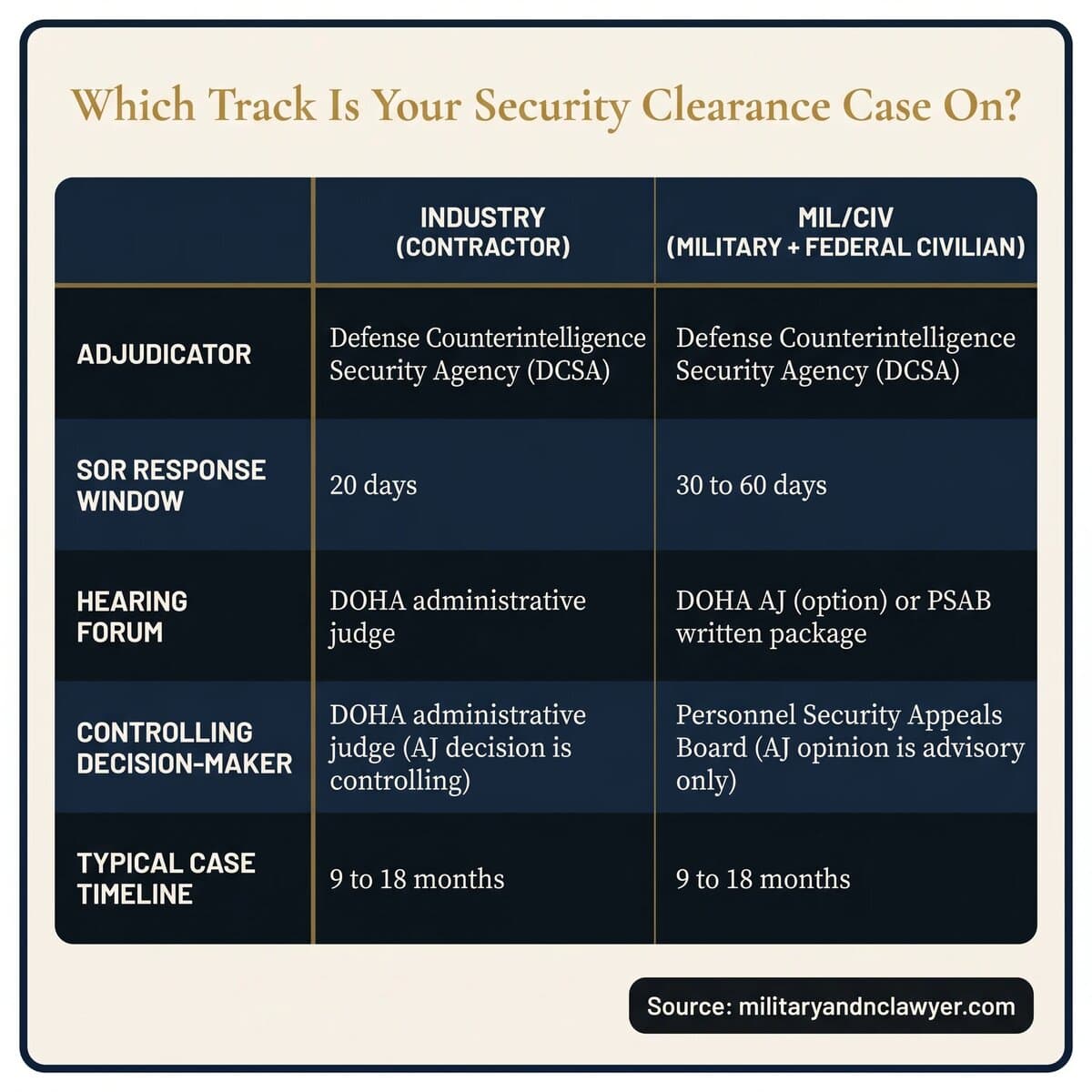
Your first instinct might be to write back immediately, explain yourself, and set the record straight. That instinct is understandable. It is also the most common mistake people make. The response window depends on the track. Industry contractors get 20 days. MIL/CIV applicants get 30 to 60. The cover letter identifies which clock is running. Filing without a strategy in the first week often costs leverage that can be difficult to recover later.
The framework that controls all of this is the Adjudicative Guidelines under 32 CFR § 147, Executive Order 12968, and Security Executive Agent Directive 4 (SEAD 4). SEAD 4 contains the 13 adjudicative guidelines used by the federal government to evaluate security clearance eligibility. These guidelines cover issues such as foreign influence, personal conduct, financial problems, alcohol-related incidents, drug involvement, criminal conduct, and mishandling protected information. Contrary to popular belief, most clearance issues are not automatic disqualifiers. Instead, each guideline contains both security concerns and mitigating conditions, and adjudicators must consider the facts as a whole. The ultimate question is not whether a concern exists, but whether the applicant's overall conduct, circumstances, and rehabilitation demonstrate that granting or continuing access to classified information is clearly consistent with the interests of national security.
SF-86 anxiety vs. an active adverse action
If you are pre-trigger and just trying to fill out an SF-86 cleanly, that is a different engagement. There is a difference between preparing for a clearance issue and defending one. SF-86 consultations are often billed hourly because the work is tailored to the individual's questions, disclosures, and timing. Clearance denials, revocations, SOR responses, and appeals are commonly handled through flat-fee or staged-fee arrangements because they involve government deadlines, formal procedures, and a defined scope of work. The right security clearance attorney should help you determine which type of engagement fits your situation rather than treating every matter as a full-blown clearance defense case.
Which Procedural Track Are You Actually On?
The single most important question to answer before hiring counsel is which agency adjudicates your case and which appeal body decides the outcome. There are three live tracks, and the right attorney for one is not always the right attorney for another. Each track is covered in more depth in the firm's security clearance defense practice area, which maps the cluster end to end.
Industry (contractor) cases under DCSA and DOHA
Defense Office of Hearings and Appeals (DOHA): the Department of Defense hearing forum that handles contested security clearance cases for many government contractors. Administrative judges conduct hearings, receive evidence, hear witness testimony, and issue written decisions. In contractor cases, those decisions may be appealed to the DOHA Appeal Board. In certain military and civilian cases, DOHA judges conduct personal appearances and provide recommendations to the Personnel Security Appeals Board, which makes the final decision.
Industry cases route through the Defense Counterintelligence Security Agency (DCSA) for adjudication. In most industrial contractor cases, if DCSA issues a Statement of Reasons (SOR), the applicant generally has 20 days to submit an answer and elect either a hearing before the Defense Office of Hearings and Appeals (DOHA) or a decision based on the written record. If a hearing is requested, a DOHA Administrative Judge (AJ) conducts a formal administrative hearing in which both sides may present evidence, call witnesses, and make legal arguments. The government is represented by Department Counsel, and the applicant may appear with counsel or proceed pro se. For industrial security clearance cases, the Administrative Judge issues the initial decision, which becomes final unless appealed to the DOHA Appeal Board. Because the Administrative Judge serves as the primary factfinder and decision-maker, the presentation of evidence, witness testimony, credibility determinations, and mitigation evidence can significantly affect the outcome.
MIL/CIV (military and federal civilian) cases
Military and civilian (MIL/CIV) security clearance cases generally follow a different process than industry contractor cases. After receiving a Statement of Reasons (SOR), the individual may submit a written response and supporting documentation through their organization's Security Management Office (SMO). DCSA evaluates the response and supporting evidence before making a determination. If the response resolves the security concerns, eligibility may be granted or restored. If the individual previously elected a personal appearance, DCSA may provide an opportunity for the individual to appear personally before a final decision is made. If DCSA ultimately issues an unfavorable decision, the individual may appeal to the appropriate Personnel Security Appeals Board (PSAB). The appeal may proceed through a written submission or, where authorized, through a personal appearance process involving a DOHA Administrative Judge. Unlike industry contractor cases, the Administrative Judge's role is advisory, and the PSAB serves as the final decision-maker.
Intelligence Community cases under ICD 704
Intelligence Community Directive 704 (ICD 704): a directive issued by the Director of National Intelligence (DNI) that establishes personnel security standards and procedures governing eligibility for access to Sensitive Compartmented Information (SCI) and other controlled intelligence programs within the Intelligence Community. ICD 704 applies to Intelligence Community elements such as the NSA, CIA, NGA, DIA, and other IC agencies, and operates separately from the Department of Defense's industrial security clearance process.
Intelligence Community (IC) cases do not route through DOHA at all. NSA, CIA, NGA, and DIA each adjudicate clearances internally under Intelligence Community Directive 704 (ICD 704) and ICPG 704.3, not under DoD Directive 5220.6. The adjudicators are different. The appeal mechanism is different. The timeline runs 6 to 12 months instead of the 9 to 18 typical for DCSA/DOHA. Most generalist clearance attorneys do not handle IC cases at all because there is no published DOHA-style case law to cite. The strategy is built from procedural experience inside the agency, not from precedent.
How to know which track you are on
Read the cover letter on whatever document arrived. It names the issuing agency and cites the controlling regulation. If it says DCSA and references DoD Directive 5220.6, you are in the DCSA/DOHA system. If it carries an NSA or DIA letterhead and references ICD 704, you are in the IC track. If you are not sure, ask a clearance attorney to read it before you respond. The triage takes one phone call.
What a Security Clearance Attorney Actually Does
A security clearance attorney does two distinct things, and most attorneys do one of them well. The first is writing the SOR or SIR response. The second is litigating the contested hearing. The skills do not overlap as much as the marketing copy suggests.
Writing the SOR or SIR response
Writing the response is a strategic exercise in disclosure and mitigation. The SOR cites specific guidelines and lays out the security concerns. An effective SOR response attorney addresses each allegation, frames the mitigating conditions under the relevant guideline, and supplies the documentary record (financial statements, character letters, treatment records, employer attestations) that builds the whole-person case. Industry SOR responses are typically bare-bones strategically if you choose to go to a hearing; you do not want to tip your hand on what the defense will look like at hearing. MIL/CIV responses are different in tone because the PSAB will read and rely on them as part of the record.
Litigating the contested DOHA hearing
Litigating the hearing is trial advocacy. At DOHA, opening statements are short. The government presents its case first, then the defense. Witnesses are called and cross-examined. Exhibits do not simply appear at hearing; they must be admitted into evidence. The defense typically provides its exhibits to opposing counsel in advance, often anywhere from five days to two weeks before the hearing. This allows objections to be addressed and the hearing to proceed more efficiently. Closing arguments tie the evidence to the mitigating conditions in the cited guidelines. The administrative judge issues a written decision after the hearing. Trial advocacy is a different muscle from drafting. Many clearance attorneys write SOR responses but lack meaningful experience advocating in contested DOHA hearings. The ability to draft a persuasive response does not necessarily translate into the ability to present evidence, examine witnesses, and litigate a DOHA case through a final decision.
Why writing and litigating are different skills
The right question to ask a prospective attorney is not "do you handle clearance cases" but "have you written this kind of response and litigated this kind of hearing recently, and how often." The answer separates the field. Preparation is the outcome. The hearing is where you present the case you built in the weeks and months before.
How Security Clearance Attorneys Charge (And What Should Cost What)
Pricing is a signal as much as a number. Flat-fee engagements signal that the firm has done enough of these matters to forecast the work. Hourly billing on clearance defense often signals the opposite. The fee bands below are typical of the security clearance defense market in 2026 and apply to a single attorney handling the matter from intake through resolution. For an end-to-end view of the DOHA and DCSA appeals process, see the appeals practice area.
SIR response engagement
SIR response (Industry or MIL/CIV): typically ranges from $1,500 to $5,000 flat fee depending on the number of guidelines cited and the complexity of the documentary record. A response targeting a single financial guideline (Adjudicative Guideline F) with a clean mitigation narrative sits at the lower end. A response addressing multiple guidelines, foreign-influence questions, or contested factual allegations sits at the upper end. Some attorneys handle SIR responses on a flat-fee basis, while others bill hourly.
Full DCSA/DOHA hearing engagement
Full DOHA hearing engagement (SOR response, evidentiary development, hearing preparation, witness preparation, and hearing representation): generally ranges from $8,000 to more than $12,000, depending on the complexity of the matter and the scope of services provided. These engagements are often structured in stages, with separate phases for the SOR response, hearing preparation, and hearing representation. The exact fee structure varies by attorney and case. Ask about staging on the intake call.
SF-86 consultation rates
SF-86 consultation: $400 per hour, typically 30 minutes to two hours per session. SF-86 work is hourly because the engagement is open-ended; the client may want a single review pass on the form, or they may want to walk through Question 23 (drug use), Question 26 (financial), or Question 22 (police record) one at a time. SF-86 consultation is not a free 15-minute call. Reasonable counsel should be clear on this distinction.
Court-martial defense (different category)
Court-martial defense: $25,000 to $50,000, with hard minimums at $30,000 for most engagements. This is a different kind of matter than security clearance defense and is handled under UCMJ rather than SEAD 4 or ICD 704. Mentioned here because clients sometimes face both at the same time, and the same attorney can sometimes handle both.
Outcome guarantees are not part of this market. No reasonable security clearance attorney offers them, and the bar rules in North Carolina and Maryland prohibit absolute statements about legal outcomes. What good counsel can offer is a candid read on the strongest mitigating conditions in your fact pattern and an honest forecast of how those conditions typically perform in front of the controlling decision-maker.
Five Questions to Ask Before You Retain a Clearance Attorney
These are the questions a panicked client never asks but should. The answers expose pretenders. Take them to every consultation. If your case sits at NSA or another Intelligence Community agency, the bar is even higher; the NSA security clearance defense practice area covers what changes inside the IC track.
How many SOR responses have you written this year?
Attorneys who maintain an active security clearance practice should be able to speak confidently and specifically about their recent experience handling similar cases. If the answer is "a few" or "occasionally," the firm is not a clearance practice; it is a generalist firm that takes clearance cases when they walk in. If the number is in the dozens, you have a working clearance practice. The volume signals the bench depth on mitigating conditions, the guidelines they have argued, and the procedural patterns they recognize.
How many DOHA hearings have you litigated to a contested decision?
This is the question that separates SOR drafters from trial counsel. Most clearance work resolves at the response stage. The ones that go to hearing are different cases, and writing a response is not the same skill as cross-examining a government witness. Ask for a count, and ask for the most recent year.
If my agency is NSA (or CIA, NGA, DIA), have you handled cases there before?
IC cases run on different rules. The adjudicators are different. The procedural rights are different. Some firms list "IC clearances" on their site and have never handled one. Ask. Then ask which agency, when, and what the disposition was. Counsel who handle IC work talk about it specifically; counsel who do not will pivot back to DCSA cases. NSA work in particular is a narrow field; only a select few attorneys nationwide have documented experience with NSA clearance cases, and most attorneys you talk to are not among them.
What is your read on the strongest mitigating condition in my fact pattern?
This question tests whether the attorney is engaging with your case or selling you a service. A useful answer cites the specific guideline at issue (Guideline E for personal conduct, Guideline F for financial, Guideline H for drug involvement) and names the mitigating condition by its SEAD 4 letter or paraphrase. A non-useful answer talks about firm credentials, past results in unrelated cases, or generic reassurance. The fact pattern controls the outcome, and a working clearance attorney will engage with yours on the first call.
Will the attorney I am hiring be the one actually handling my case?
Larger firms often quote senior partner credentials at intake and then assign the work to a junior. Solo and small-firm practices answer this question honestly because they have to. There is nothing wrong with associate involvement on appropriate tasks. There is something wrong with hiring one attorney and ending up with a different one at the hearing.
If you remember nothing else from these five questions, remember the first two and the fifth. They are the ones that filter the marketing language out fastest.