
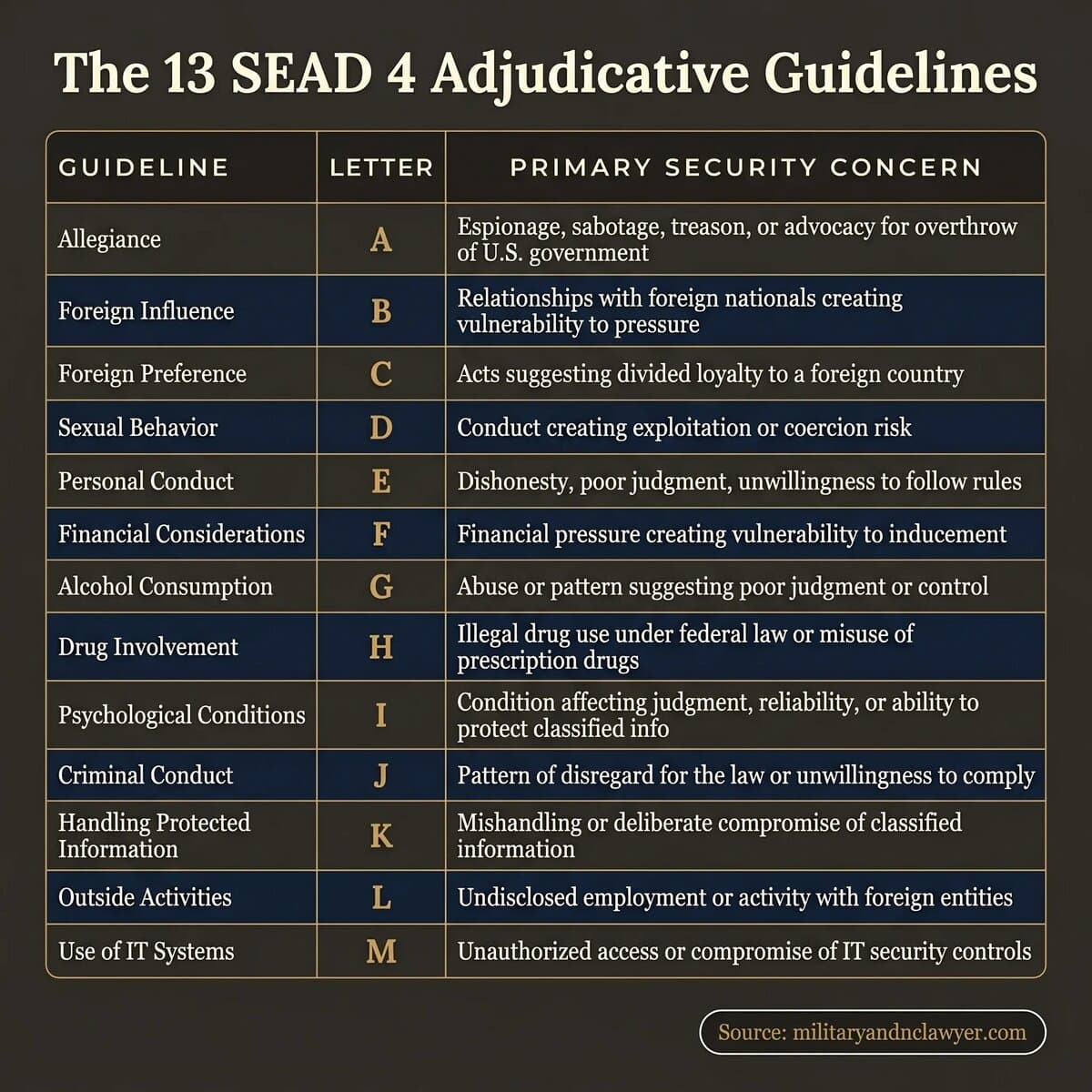
The Adjudicative Guidelines are the 13 categories of security concerns used by the federal government to evaluate an individual's eligibility for access to classified information. They address issues such as personal conduct, foreign influence, financial considerations, and other factors relevant to national security. Published under Security Executive Agent Directive 4 (SEAD 4), these guidelines define both the security concerns that can disqualify an applicant and the mitigating conditions that can overcome those concerns. No single guideline operates as an absolute bar. The adjudicator weighs the whole person across all 13.
SEAD 4 Is the Governing Framework, Not a List of Automatic Disqualifiers
Most people who have received a Statement of Reasons (SOR) encounter the adjudicative guidelines for the first time in that document. The SOR identifies which guidelines apply to their case, lists the factual basis for each concern, and explains what the government has concluded from those facts.
Adjudicative Guidelines: the 13 categories of conduct and circumstances defined under Security Executive Agent Directive 4 (SEAD 4) that federal adjudicators use to evaluate whether a person is eligible for access to classified information.
The first thing to understand about the adjudicative guidelines is what they are not. SEAD 4 does not list absolute disqualifiers. It lists 13 guidelines with security concerns and mitigating conditions under each. The adjudicator applies the whole-person standard, which means every relevant factor about the applicant, including the positive factors, enters the analysis. A concern under Guideline F does not necessarily result in a clearance denial. What matters is the cause, the response, and the status.
The 13 Adjudicative Guidelines Under SEAD 4
Guideline A: Allegiance to the United States
Security concern: acts of sabotage, espionage, treason, or advocacy for overthrow of the U.S. government; membership in organizations dedicated to those goals.
Mitigating conditions: the behavior was not recent; the person has clearly changed; the organization was not dedicated to those goals at the time of membership; the behavior was coerced.
This is one of the most serious guidelines in the framework. Cases involving Guideline A are rarely resolved without extensive documentation of changed circumstances. Cases involving actual espionage or sabotage are rarely resolved in the applicant's favor.
Guideline B: Foreign Influence
Security concern: a close and continuing association with foreign nationals or foreign governments that could create pressure to act contrary to U.S. interests, or susceptibility to foreign influence, inducement, or coercion.
Mitigating conditions: the contact is not recent, has been reported, is infrequent and not operationally sensitive, or the person has clearly demonstrated the primacy of U.S. loyalty over the foreign relationship.
Foreign national spouses, family members in controlled countries, and dual citizenship all surface here. The concern is often broader than disloyalty alone, extending to potential vulnerability to foreign influence or pressure.
Guideline C: Foreign Preference
Security concern: acquiring citizenship in a foreign country, taking an oath of allegiance to a foreign government, serving in a foreign military, or accepting a position in a foreign government.
Mitigating conditions: the act was involuntary; the person has taken steps to renounce foreign citizenship or otherwise demonstrate primary U.S. loyalty; the foreign preference is not recent.
Dual citizenship is not necessarily disqualifying. What matters is whether the circumstances suggest a divided loyalty that could be exploited.
Guideline D: Sexual Behavior
Security concern: sexual behavior that involves a criminal offense, indicates poor judgment, lack of discretion, or could make the person susceptible to exploitation or coercion.
Mitigating conditions: the behavior is not recent, was isolated, or the person has demonstrated sound judgment and is not susceptible to exploitation based on that behavior.
This guideline has contracted significantly in application following legal changes regarding same-sex relationships. Its current primary application involves coercion risk from conduct the person has not disclosed.
Guideline E: Personal Conduct
Security concern: questionable judgment; a pattern of dishonesty; unwillingness to comply with rules and regulations; evidence that the person is not reliable or trustworthy.
Mitigating conditions: the behavior was not recent; the person has acknowledged the behavior and taken corrective steps; the behavior did not reflect a pattern or broader character issue.
Guideline E is often the guideline the adjudicator adds to a case that was initially filed on a different ground. If the SOR alleges drug use under Guideline H and also claims the applicant was dishonest on the SF-86, Guideline E appears for the dishonesty concern. Candor and transparency matter throughout the entire process, before and after the initial adjudication.
Guideline F: Financial Considerations
Security concern: a person who cannot manage their finances may be susceptible to financial inducement, may commit theft, or may engage in other conduct contrary to the national interest in order to resolve financial pressure.
Mitigating conditions: the condition is not recent; the person has documented good-faith efforts to resolve the debt; the condition was the result of circumstances beyond the applicant's control; a legitimate financial counseling or bankruptcy process has been completed.
Guideline F cases are the most common reason for clearance denial and suspension. The adjudicator is not evaluating whether the applicant has debt (plenty of cleared professionals carry debt). The analysis focuses on the cause, the response, and the status.
Guideline G: Alcohol Consumption
Security concern: alcohol abuse, excessive consumption, or any alcohol-related conduct that indicates poor judgment, loss of control, or susceptibility to exploitation.
Mitigating conditions: the problem is not recent; the person has successfully completed counseling or treatment and demonstrates a sustained period of changed behavior; the person has acknowledged the problem.
A single alcohol-related incident does not produce a Guideline G concern in most cases. The adjudicator is looking for a pattern or for conduct (an alcohol-related DUI, an alcohol-related arrest, documented episodes at work) that signals a sustained problem.
Guideline H: Drug Involvement and Substance Misuse
Security concern: illegal drug use under federal law, misuse of legally prescribed drugs, drug trafficking, or any connection to illegal drug activity that creates a nexus to the applicant.
Mitigating conditions: the use was not recent; the person has clearly demonstrated that the use is not likely to recur; the person has successfully completed treatment; the person voluntarily disclosed the use and has not used since.
The federal standard governs, not state law. A cleared federal contractor in Colorado who uses marijuana legally under state law remains in violation of the federal standard. CBD products are not subject to the same federal testing and oversight standards as many regulated substances, creating a risk that THC concentrations may differ from what is advertised. For individuals in federally cleared positions, that uncertainty can create concerns under Guideline H, especially if the applicant fails a drug test. Accurate SF-86 disclosure plus documented abstinence is the canonical mitigation path.
Guideline I: Psychological Conditions
Security concern: a psychological condition that may cause a deficiency in judgment, reliability, or any other condition that could affect the applicant's ability to safeguard classified information.
Mitigating conditions: the condition is under control; the person is receiving treatment; the treatment is ongoing and compliance is documented; the condition is not severe enough to impair judgment.
Adjudicators give significant weight to evaluations from mental health professionals. A psychological condition that is well-managed and documented is frequently mitigated. The adjudicator is not making a clinical judgment; that is the mental health professional's role. The adjudicator is evaluating whether the condition creates a risk to classified information.
Guideline J: Criminal Conduct
Security concern: criminal charges or convictions that demonstrate a willingness to violate the law, or conduct suggesting a disregard for the law even without a conviction.
Mitigating conditions: the conduct was not recent; the person was not convicted or charges were dropped; the person has demonstrated good judgment and law-abiding conduct since; the conduct was youthful and isolated; the person has completed all terms of any sentence.
A conviction is not necessarily disqualifying. The adjudicator evaluates whether the conduct demonstrates a pattern or a character issue. A single conviction from 15 years ago with a clean record since is a very different case from multiple recent incidents.
Guideline K: Handling Protected Information
Security concern: mishandling or deliberate compromise of classified information; allowing unauthorized access; failure to follow proper classification and dissemination protocols.
Mitigating conditions: the violation was not recent; the person has acknowledged the violation and taken corrective steps; the violation was unintentional; the violation resulted in minimal damage; the person has since demonstrated reliable handling.
Guideline L: Outside Activities
Security concern: employment with or service to a foreign national, foreign government, or foreign business without disclosure; unauthorized participation in foreign commercial or academic relationships.
Mitigating conditions: the relationship was disclosed; the employment was infrequent and not sensitive; the person has terminated the relationship.
Guideline M: Use of Information Technology Systems
Security concern: unauthorized access to or modification of information technology systems; deliberate compromise of IT security protocols; circumvention of security controls.
Mitigating conditions: the violation was not recent; the person has acknowledged the violation; the violation was unintentional or minor; the person has since demonstrated compliance.
How the Whole-Person Standard Works in Practice
The whole-person standard is not a slogan. It is the operative framework that requires a whole-person assessment rather than a determination based on any one factor alone.
The whole-person standard: the requirement under SEAD 4 that adjudicators consider the totality of a person's life when evaluating security eligibility, not just the derogatory information, but all relevant positive factors including the nature of any misconduct, how it was resolved, the person's overall record, and any evidence of rehabilitation or changed circumstances.
When an adjudicator reviews a case, the positive factors on the table include: employment history, education and professional accomplishments, prior service, community involvement, character references, financial recovery steps, voluntary disclosure, cooperation with the investigation, and the overall arc of the applicant's life relative to the concern.
The cause, the response, and the status of the concern determine most cases. A person who accumulated substantial debt due to a medical emergency, disclosed the full picture on the SF-86, entered a debt management plan, and has been current on all obligations for two years is in a fundamentally different position than a person who accumulated debt through gambling, concealed it on the SF-86, and has not addressed it. Both face Guideline F. The strength of the mitigation evidence varies significantly among them.
How Multiple Guidelines Compound
The thirteen guidelines do not always appear alone. The single most consequential pattern in clearance adjudication is two or more guidelines compounding on a single set of facts.
Personal Conduct (Guideline E) is the multiplier. Almost any other guideline can pair with Guideline E when the underlying conduct involves a failure to disclose, an attempt to conceal, or a misrepresentation on the SF-86 or to investigators. A Guideline F financial issue accompanied by Guideline E disclosure failures becomes a fundamentally different file than the same financial issue with full disclosure. The credibility damage spreads to every other claim in the response: a person who concealed debt is harder to believe when claiming the debt is now resolved.
Drug Involvement (Guideline H) and Personal Conduct (Guideline E) are a particularly common pairing. A positive urinalysis under Article 112a triggers Guideline H. Failure to disclose prior drug use on the SF-86, even use that pre-dated service, triggers Guideline E. Adjudicators see this combination frequently and weight the disclosure failure heavily, because it suggests the applicant either does not understand the disclosure obligation or chose to ignore it.
Foreign Influence (Guideline B) and Foreign Preference (Guideline C) can overlap when an applicant has dual citizenship and significant foreign ties. While each concern is evaluated on its own merits, the combination may warrant closer scrutiny and should be addressed directly in the response.
Alcohol Consumption (Guideline G) and Criminal Conduct (Guideline J) compound where the applicant has a DUI history. Guideline G captures the underlying pattern of alcohol use; Guideline J captures the criminal conviction. The mitigation requires evidence on both fronts: documented sobriety and treatment completion for Guideline G, and the resolution of legal consequences for Guideline J.
When compounding appears, the response strategy changes. A single-guideline response can lean heavily on the strongest mitigating factor available. A multi-guideline response must address each guideline on its own terms, in the right order, with a unified narrative that explains the overall pattern without making the file look worse than it is. This is one of the practitioner-level distinctions between a strong SOR response and a weak one.