
Most security clearance issues are not automatic disqualifiers, although certain statutory restrictions, including the Bond Amendment, can create eligibility barriers that may require a waiver. Security Executive Agent Directive 4 (SEAD 4) lists 13 Adjudicative Guidelines with security concerns AND mitigating conditions, weighed under the whole-person standard. The five guidelines that drive most denials (Financial, Drug Involvement, Personal Conduct, Foreign Influence, Criminal Conduct) are commonly cited disqualifying factors, not automatic disqualifiers.
You searched "5 automatic disqualifiers for security clearances" because you have an issue, or you think you might, and you want to know whether the door is closed before you waste any more time. The answer is not what the search query implies, and the difference matters. There is no list of automatic disqualifiers listed in the SEAD 4. There are 13 Adjudicative Guidelines under Security Executive Agent Directive 4 (SEAD 4), each with security concerns AND mitigating conditions, and a whole-person standard that controls every adjudication. Knowing which guidelines drive most denials is useful. Believing any of them is automatic is a mistake that can cost people clearances they could have kept.
Automatic Disqualifiers (Why Context Matters)
Automatic disqualifier: a phrase that appears in search queries and competitor blog posts but rarely exists in the federal security clearance adjudication framework. SEAD 4, EO 12968, and 32 CFR § 147 do not list automatic disqualifiers; they list 13 Adjudicative Guidelines with security concerns and mitigating conditions, weighed under the whole-person standard.
The framework is straightforward when you read it. SEAD 4 (Security Executive Agent Directive 4) lists 13 Adjudicative Guidelines, lettered A through M, covering issues from allegiance to use of information technology. Each guideline names the security concerns that may be raised by certain conduct AND the mitigating conditions that can resolve those concerns. There is no point in any guideline at which the framework says "this is an automatic disqualifier." The framework is built on the opposite premise.
One nuance: the Bond Amendment
For many people pursuing a security clearance, the Bond Amendment is one of the few statutory restrictions that can create a direct barrier to eligibility. Under federal law, an agency head may not grant or renew a security clearance for an individual who is an unlawful user of a controlled substance or who is an addict as those terms are defined by federal law. See 50 U.S.C. § 3343 (2008).
Department of Defense guidance provides important definitions for these terms. An unlawful user of a controlled substance includes:
- a person who uses a controlled substance and has lost the power of self-control regarding that use, as well as any current user who uses a controlled substance other than as prescribed by a licensed physician.
- the term use includes any use recent enough to indicate that the individual is actively engaged in such conduct.
- an addict is an individual who habitually uses narcotic drugs in a manner that endangers public morals, health, safety, or welfare, or who has lost the power of self-control because of addiction. See DoDM 5200.02, App. 7B, ¶ 7B.3(b)(1)-(2).
The Bond Amendment also imposes additional restrictions on access to particularly sensitive information, including Sensitive Compartmented Information (SCI), Special Access Programs (SAPs), and Restricted Data (RD). Unless a written waiver is granted, such access may not be provided to an individual who:
- Has been convicted of a crime in a U.S. court, sentenced to imprisonment for more than one year, and incarcerated for at least one year as a result of that sentence;
- Has been discharged or dismissed from the Armed Forces under dishonorable conditions; or
- Has been determined to be mentally incompetent by an adjudicative authority based on an evaluation by a qualified mental health professional and consistent with the applicable adjudicative guidelines.
These restrictions apply broadly, including to Department of Energy Q and L clearances, although exceptions may be available under Appendix B of SEAD 4.
Importantly, a Bond Amendment disqualification is not always the end of the road. In certain cases, an adjudicator may determine that the facts support a favorable security clearance decision under the normal mitigating conditions of the Adjudicative Guidelines, but for the Bond Amendment restriction. In those circumstances, a meritorious waiver may be considered. Such waivers are treated as an exception to the adjudicative guidelines, must be specifically documented, and require a written technical justification. If a waiver is not granted, the requested SCI, SAP, or Restricted Data access will be denied or revoked, and the individual will receive a written explanation with information about the applicable review process. See SEAD 4, App. B.
The practical takeaway is that while the Bond Amendment creates significant statutory restrictions, it does not necessarily create a permanent bar in every case. The facts, mitigating evidence, and availability of a meritorious waiver can all play an important role in determining the final outcome.
What people mean when they search "5 automatic disqualifiers"
The search query usually carries one of three concerns. The first is debt: a bankruptcy, collections, or sustained delinquency the applicant believes will end the clearance. The second is drug use: marijuana use in a state where it is legal, a positive urinalysis, or historical recreational use the applicant has not disclosed before. The third is criminal history: an arrest, a conviction, a deferred prosecution, or a record sealed years ago that the applicant does not know how to characterize on the SF-86. Each of these may produce a security concern under one of the SEAD 4 guidelines. Many of these concerns can be mitigated, depending on the circumstances, and shouldn't be viewed as an automatic disqualifier.
What SEAD 4 actually says
Security Executive Agent Directive 4 (SEAD 4): the federal directive establishing the 13 Adjudicative Guidelines for determining eligibility for access to classified information, codified at 32 CFR § 147 and applied across the DoD, the Intelligence Community, and federal civilian agencies under Executive Order 12968.
SEAD 4 establishes the security concern AND the mitigating conditions for each of the 13 guidelines. Take Guideline F (Financial Considerations) as the example. The security concern is that "failure to live within one's means, satisfy debts, and meet financial obligations may indicate poor self-control, lack of judgment, or unwillingness to abide by rules and regulations." That sounds bad. The next paragraph lists mitigating conditions, including conditions where "the behavior happened so long ago, was so infrequent, or occurred under such circumstances that it is unlikely to recur and does not cast doubt on the individual's reliability, trustworthiness, or good judgment." There are seven mitigating conditions under Guideline F alone. Each provides a potential basis for addressing the underlying security concern.
The whole-person standard
Whole-person standard: SEAD 4 requires adjudicators to apply the whole-person concept, evaluating the totality of an individual's conduct, character, circumstances, and potential for future reliability rather than relying on any single factor in isolation. This principle is set forth in SEAD 4's Adjudicative Process section and applies across all 13 Adjudicative Guidelines.
SEAD 4 explicitly adopts a whole-person concept. Adjudicators evaluate the applicant's character, conduct, and circumstances as a totality, not as a checklist. A single security concern under one guideline often does not produce a denial when the rest of the file shows reliability and stability. A pattern of issues across multiple guidelines, even minor ones individually, can produce a denial when the totality casts doubt. Adjudicators are tasked with determining whether granting a clearance is clearly consistent with national security interests, considering both security concerns and mitigating information. The mitigation evidence is what gives them that reason.
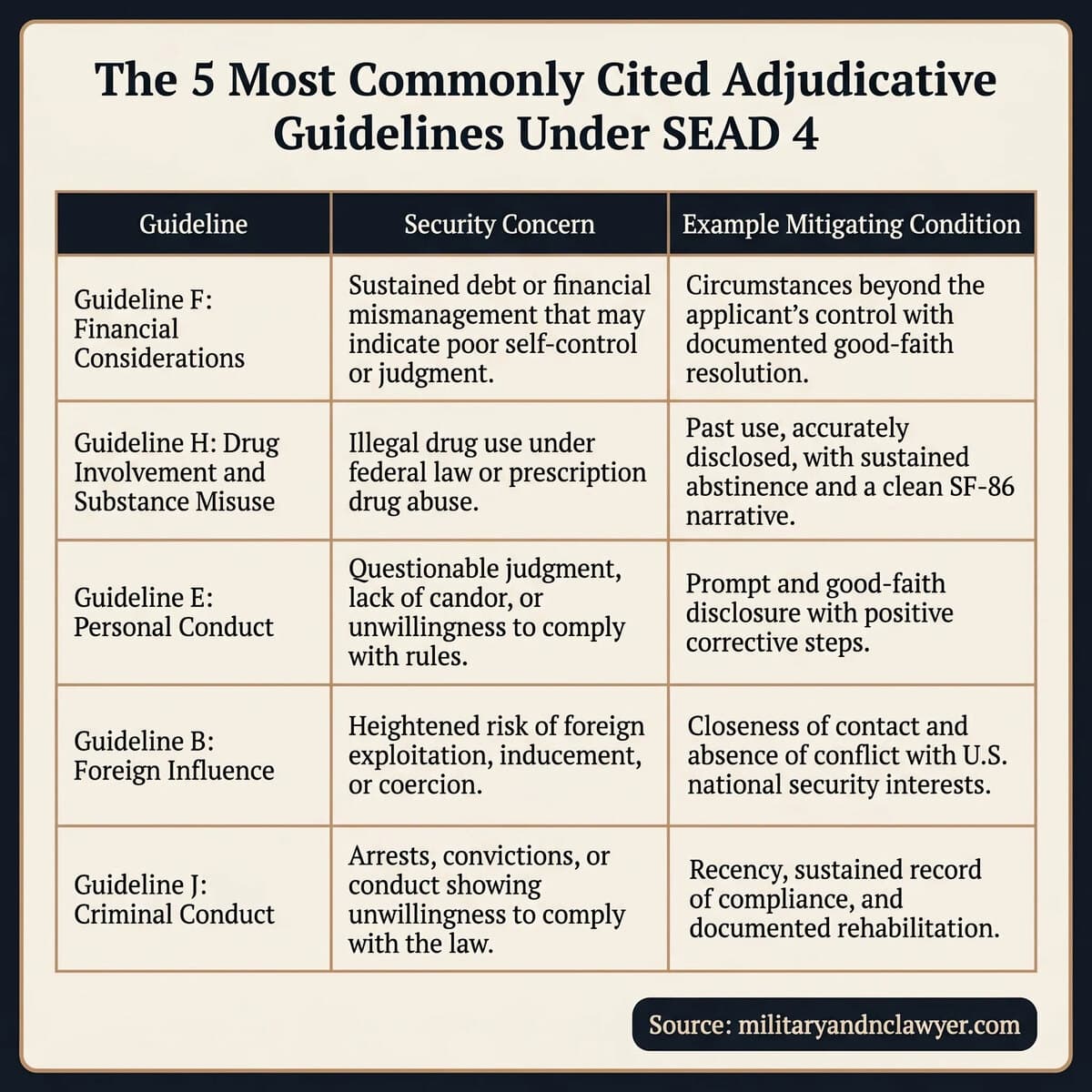
The 5 Most Commonly Cited Adjudicative Guidelines
Adjudicative Guidelines: the 13 lettered guidelines (A through M) under SEAD 4 that adjudicators apply to evaluate eligibility for access to classified information; each guideline names security concerns AND mitigating conditions, never disqualifiers in isolation.
These five guidelines drive the majority of denials and Statements of Reasons in the federal clearance system. They are commonly cited disqualifying factors, not automatic disqualifiers. Each operates under the same security-concern-plus-mitigating-conditions structure described above. These issues are frequently manageable when the facts support meaningful mitigation. The security clearance defense practice area covers the full appeals path end to end.
Guideline F: Financial Considerations (the most common)
Guideline F appears in more Statements of Reasons than any other guideline. The security concern centers on failure to manage debt, sustained delinquency, bankruptcy filings, unpaid taxes, gambling-related debt, or financial conduct that suggests poor judgment. Most people misunderstand Guideline F cases. The adjudicator is not simply looking at whether you have debt. Plenty of cleared individuals carry debt. The adjudicator is evaluating three things: the cause, the response, and the status. Mitigating conditions include circumstances beyond the applicant's control (job loss, divorce, medical emergency), good-faith efforts to resolve the debt, financial counseling, and a sustained pattern of recovery. In many cases, documented repayment efforts, a track record of responsible behavior, and a credible narrative can help address financial concerns.
Guideline H: Drug Involvement and Substance Misuse
Guideline H covers illegal drug use under federal law, prescription drug abuse, and substance-related conduct. The federal standard governs. Marijuana legal under state law is still a Guideline H concern at the federal level. The mitigating conditions include the recency of the use, the frequency, the circumstances, evidence of an intention not to recur, and (for treatment cases) successful completion of a treatment program with a favorable prognosis. A single past use, disclosed accurately, with sustained abstinence and a clean SF-86 narrative, mitigates differently than ongoing or recent use. Guideline H is often winnable. Cases involving incomplete disclosures can be more challenging, especially when the omitted information is later independently verified.
Guideline E: Personal Conduct
Guideline E is the all-purpose guideline. It covers any conduct involving "questionable judgment, lack of candor, dishonesty, or unwillingness to comply with rules and regulations." When a financial issue (Guideline F) involves an undisclosed delinquency, it often becomes a Guideline E case as well, because the candor question matters more to the adjudicator than the underlying debt. Mitigating conditions include the conduct happening so long ago that it does not reflect current reliability, prompt and good-faith disclosure once the conduct was identified, and evidence the applicant has taken positive steps to correct the underlying behavior. Guideline E is the guideline most often added on the back of another guideline, and one that frequently turns on an applicant's candor and credibility in responding to the concerns raised.
Guideline B: Foreign Influence
Guideline B covers foreign contacts, foreign property, foreign business interests, and conduct that creates a "heightened risk of foreign exploitation, inducement, manipulation, pressure, or coercion." The framework recognizes that many cleared professionals have foreign-born relatives, foreign property, or foreign professional contacts. Mitigating conditions include the nature of the foreign country (close-allied vs. adversarial), the closeness of the contact, the applicant's willingness to report contacts, and the absence of any conflict between the foreign tie and U.S. national security. Guideline B cases require careful documentary work. Generic responses often fail.
Guideline J: Criminal Conduct
Guideline J covers arrests, convictions, deferred prosecutions, and conduct that suggests an unwillingness to comply with the law. Like the other guidelines, mitigating conditions are central. The recency of the conduct, the seriousness, the underlying factual record, and the evidence of rehabilitation all matter. An old conviction, fully disclosed, with a sustained record of compliance, mitigates differently than a recent arrest the applicant tried to omit. The adjudicator reads the SF-86 alongside the law enforcement record. Discrepancies between the two can move a Guideline J case from concern to denial.
How the Whole-Person Standard Actually Decides Cases
The whole-person concept is a foundational principle of security clearance adjudication, and is often glossed over by content that lists "the 5 disqualifiers" as if they were dispositive. The standard requires adjudicators to weigh the totality of the applicant's character and conduct, not the existence of any single concern.
The whole-person factors adjudicators weigh
SEAD 4 directs adjudicators to consider, among other factors, the nature, extent, and seriousness of the conduct; the circumstances surrounding the conduct, to include knowledgeable participation; the frequency and recency of the conduct; the individual's age and maturity at the time of the conduct; the extent to which the participation is voluntary; and the presence or absence of rehabilitation. These factors apply across all 13 guidelines. They are why a 20-year-old college incident typically does not control a 45-year-old cleared engineer's adjudication, and why a recent and ongoing pattern of any conduct can carry more weight than its severity in isolation.
Why mitigation strength is what controls outcome
The cause is rarely the controlling variable. The response is. A clearance applicant who took ownership early, documented the underlying issue, completed any treatment or financial-counseling program available, and built a sustained record before any government attention is in a substantively different position than the applicant who waited for the SOR to act. What the applicant did before the matter became a security file controls more weight than what the applicant says about it after.
The frequency, recency, voluntariness, and remediation framework
These four factors recur across guideline assessments. Frequency involves both the number of occurrences and the pattern they reveal over time. Recency means how close the conduct is to the present, with a sliding scale that reaches back further for serious conduct than for minor. Voluntariness asks whether the applicant chose the conduct or was constrained into it (a major analytical move under Guideline B). Remediation asks whether the applicant has taken sustained, documented steps to ensure the conduct does not recur. The factors are why two applicants with the exact same underlying issue can land at different outcomes. The fact pattern controls the outcome, and within the fact pattern, mitigation controls everything.
What Actually Happens If You Have One of These Issues
The framework matters because what you do at each stage of the process is what determines whether a security concern produces a denial. The stages are predictable. The leverage at each stage is not the same.
Pre-adjudication: the SF-86 disclosure window
Most clearance issues are resolvable on the SF-86 with a candid disclosure, a clear narrative, and the supporting documentation that establishes the mitigating conditions before the adjudicator ever raises a concern. SF-86 review is a paid hourly engagement; the form is the applicant's, the timeline is the applicant's, and the cost of getting it right is small relative to the cost of explaining a non-disclosure later. The mitigating conditions for every guideline are easier to apply when the disclosure happens at the SF-86 stage rather than after a Statement of Reasons issues.
Post-adjudication: the SOR response and DOHA process
Once a Statement of Reasons is issued, the procedural clock starts. Industry contractors have 20 days to respond. Military and federal civilian applicants have 30 to 60 days. The SOR response is often the first substantive opportunity to address the government's security concerns. It becomes part of the adjudicative record and may influence whether the matter can be resolved on the written record or proceeds to a hearing. An effective response typically addresses each cited guideline, identifies applicable mitigating factors, and provides supporting documentation where available. The denial and revocation defense practice area maps the response and hearing procedure end to end. For the upstream stage, the SF-86 consultation practice area covers what the disclosure framing should look like before any of these guideline issues become a security file.
Where retainer counsel changes the math
Counsel changes the math at three points. The first is SF-86 review, where the disclosure framing is set. The second is the SOR response, where the documentary record is built and the mitigating conditions are framed against the cited guidelines. The third is the contested DOHA hearing, where trial advocacy becomes the controlling skill. Most clearance defense work centers on the response stage. The cases that go to hearing require a different muscle than the response work, and not every clearance attorney is a trial attorney. Among the best times to retain counsel is when a Statement of Reasons or Supplemental Information Request lands. For SF-86 work, paid consultation is the appropriate engagement structure; the form itself is not a free-call trigger.