
NJP punishments under the Uniform Code of Military Justice (UCMJ) are set by MCM Part V and service regulations. The maximum punishment a commanding officer can impose depends on the CO's rank and the service member's grade. A company grade officer cannot impose the same punishment ceiling as a field grade or general officer. Understanding the punishment table before NJP is held is the first step in assessing whether to accept or refuse the proceeding.
How NJP Punishment Authority Works
Non-judicial punishment (NJP): a disciplinary proceeding conducted by a commanding officer under Article 15, UCMJ and MCM Part V, also known as Office Hours in the Marine Corps, Captain's Mast in the Navy and Coast Guard, and Article 15 in the Army, Air Force and Space Force. NJP is not a court-martial. It is not a criminal proceeding. It does not result in a federal criminal conviction. The CO hears the evidence, makes a finding, and imposes punishment within the limits set by MCM Part V, Article 15, UCMJ and service specific regulations.
The commanding officer has discretion within the MCM Part V and service regulations ceiling. The ceiling is determined by the CO's rank, not by the offense. A CO can impose any combination of authorized punishments up to the maximum, but cannot exceed the table for their grade.
The practical consequence: a service member facing NJP from a company grade officer faces a lower maximum punishment than the same service member facing NJP from a field grade or general officer. Knowing which table applies before the proceeding begins matters.
MCM Part V also sets limits based on the service member's grade. Reduction in grade, for example, is not available at the company grade level in some services. A company grade CO cannot reduce an E-5 to E-4. A field grade CO can.
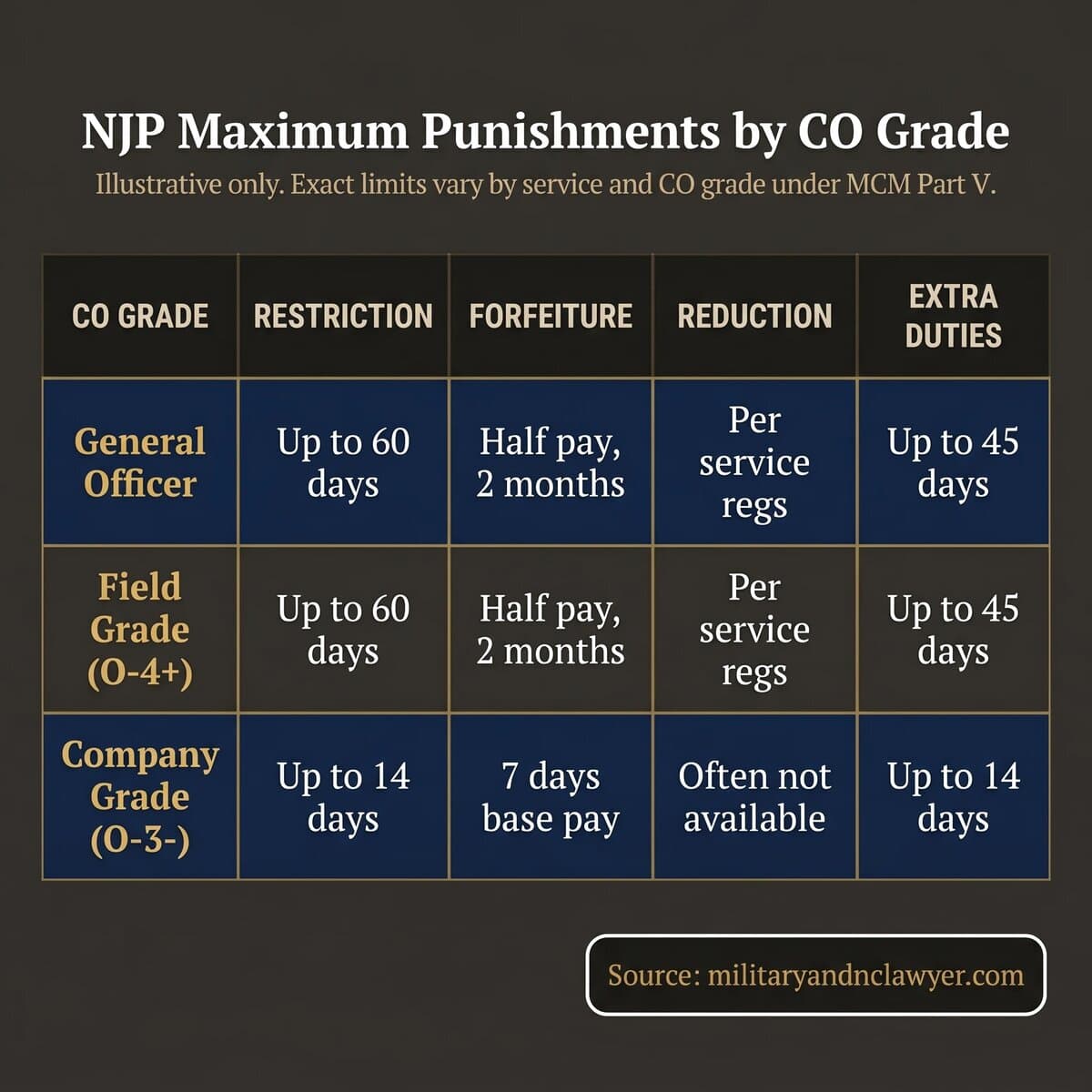
The NJP Punishment Table by CO Grade
General officer commanding officer. The highest punishment authority at NJP. Can impose: restriction to specified limits for up to 60 days; forfeiture of pay not to exceed half of one month's base pay per month for two months; reduction in grade; extra duties for up to 45 days; an oral reprimand.
Field grade officer commanding officer (O-4 and above). A commanding officer of the grade of major or lieutenant commander or above, or a principal assistant as defined in MCM Part V, may impose: forfeiture of not more than one-half of one month's pay per month for two months; reduction in grade, which at NJP may only be imposed if the grade from which demoted is within the promotion authority of the officer imposing the reduction, with Marines reduced only to the next inferior paygrade and Marines in the grade of E-6 or above and Sailors in the grade of E-7 or above not subject to reduction; extra duties, including fatigue or other duties, for not more than 45 consecutive days; and an oral reprimand. Restriction to specified limits for not more than 60 consecutive days is authorized; however, if 45 days of extra duties are imposed, restriction may not exceed 45 days.
Company grade officer commanding officer (O-3 and below). A commanding officer of the grade of captain or lieutenant (O-3) and below exercising company command may impose: forfeiture of not more than 7 days' pay; reduction in grade only if authorized under the promotion authority described above for field grade officers; extra duties, including fatigue or other duties, for not more than 14 consecutive days; restriction to specified limits, with or without suspension from duty, for not more than 14 consecutive days; an oral reprimand.
These are maximums. The CO can impose any combination within the ceiling. Imposing restriction and forfeiture together is common. In many cases, commanding officers impose the full range of authorized punishments, though a strong mitigation and extenuation package can sometimes lead to a more favorable outcome. The CO has full discretion below the ceiling.
The figures above are illustrative. The exact authorities and limits vary by service and by the CO's grade, because each branch sets its own NJP regulations under MCM Part V. The chart is a general guide, not a uniform rule that applies identically across the armed forces.
What Each Punishment Means Practically
Forfeiture of pay. Calculated as a percentage of base pay, not total compensation. BAH, BAS, and special pays are not affected. Forfeiture does not reduce VA benefits or retirement points. A forfeiture of half pay for one month at E-4 typically means several hundred dollars. The amount is deducted from the service member's next pay cycle.
Reduction in grade. The most consequential punishment for career trajectory. A reduction in grade equals a reduction in status and respect, which affects billet eligibility, leadership responsibilities, and re-enlistment options. A reduction in grade typically remains in effect unless successfully appealed or set aside. It appears in the service record and may affect promotion or reenlistment eligibility in the future.
Restriction to specified limits. The service member cannot leave the restriction limits during liberty hours. They continue to perform all regular duties. Restriction is not confinement. It does not affect pay. It affects personal freedom during off-duty hours.
Extra duties. Additional duties assigned on top of the service member's regular schedule. In practice, this is often administrative work, cleaning details, or additional physical training.
Oral reprimand. The least severe authorized punishment. The CO formally censures the service member's conduct. An oral reprimand standing alone typically leaves no paper trail. A CO who issues an oral reprimand and memorializes it through a formal counseling creates a service record entry. The oral reprimand itself, without a written counseling, typically does not appear in the service record.
What goes in the service record. The NJP finding and punishment are recorded in the service record. NJP records, supporting documentation, administrative remarks, counseling entries, and related personnel records may contain descriptions of the underlying misconduct depending on the service.
How to Challenge NJP Punishments
A service member has the right to appeal NJP punishments to the next superior authority. The window is five days from the date the punishment is imposed. Missing that window can forfeit the appeal right.
The appeal goes up the chain of command, not to an independent judicial body. At installations like Camp Lejeune, the superior authority in the Marine Corps chain reviews the appeal record and can reduce, suspend, or set aside any portion of the punishment. The superior authority can also approve the punishment as imposed.
What the superior authority evaluates: whether the CO had sufficient evidence to support the finding; whether the punishment was proportionate to the offense and the service member's record; whether any procedural error occurred at the NJP proceeding.
Effective NJP appeals are built on specific grounds: the punishment exceeded the MCM Part V ceiling for the CO's grade, the service member was denied the opportunity to present evidence, or the evidence did not support the finding. A general claim that the punishment was unfair without a specific legal or factual basis is less likely to succeed.
If a reduction in grade was imposed and the appeal succeeds, the service record is corrected. The service member is restored to the prior grade.
NJP and Downstream Consequences
NJP does not create a federal criminal record. It does create a military service record entry. That entry follows the service member.
Security clearance. NJP can trigger a clearance concern under Guideline E (Personal Conduct) or Guideline J (Criminal Conduct) of the SEAD 4 adjudicative guidelines. A single isolated NJP from years ago is often mitigated under the whole-person standard and applicable mitigating factors. A pattern of NJP, or an NJP for drug involvement under Guideline H, is more difficult to mitigate.
Administrative separation. An NJP may lead to administrative separation, but the outcome depends on the underlying misconduct and the requirements of the applicable service regulations. A service member who received an NJP and has an underlying service record issue may also want to review the Boards for Correction of Military Records (BCNR, ABCMR, AFBCMR) process for correcting service record entries that could compound downstream consequences. A single NJP can serve as a basis for an administrative separation if the command elects to pursue one. Separation initiated following NJP requires the same procedural protections as any other administrative separation: written notification, the right to consult counsel, and the right to a board if the service member has sufficient time in service.
Re-enlistment. NJP can have lasting career consequences, including impacts on reenlistment, retention, promotion, and future service opportunities. The extent of those consequences depends on the service branch, the nature of the misconduct, and the service member's overall record.
If you received NJP and are now facing a security clearance SOR, a separation notice, or questions about your re-enlistment eligibility, schedule a free 15-minute triage call before the response deadlines begin to run. Additional practice information is available through the practice areas hub attorney page.
When the CO's Discretion Cuts in Your Favor
The same Article 15 authority that allows a commanding officer to impose the maximum punishment in the grade-based table also gives that officer significant downward discretion. The CO can suspend any portion of the punishment, can impose less than the maximum on any specific item, and can decline to impose certain authorized punishments at all. Understanding how that discretion is exercised, and how to influence it, is the practical work the service member and counsel do between the NJP notification and the imposition decision.
Three factors most often pull a CO's exercise of discretion downward. First, the service member's overall service record. A first-offense NJP for a single isolated incident, when the rest of the record is clean (meritorious fitness reports, completed schools, achievements, leadership roles), gives the CO grounds to impose a punishment at the lower end of the authorized range. The CO's decision is informed by the file the command SJA prepares; counsel involvement focuses on ensuring that file accurately represents the service member's record.
Second, contemporaneous remediation. A service member who took responsibility immediately, sought counseling on their own initiative, made restitution where applicable, or completed corrective education before the NJP date demonstrates a trajectory that supports a lower-end punishment. The remediation must be documented; verbal accounts of remediation that the file does not corroborate carry less weight.
Third, the disposition that achieves the unit's goal at the lowest cost. NJP is a discipline tool, not a punishment in the abstract. A CO's goal is to maintain unit standards and address the specific conduct. Where the service member's underlying issue is addressable through counseling, training, or a temporary duty restriction rather than a reduction in grade, COs often elect the lower-impact option that achieves the discipline goal.
Three factors often pull a CO's exercise of discretion upward. A pattern of prior misconduct. An offense that affected mission readiness or unit cohesion. Conduct involving classified information, sensitive duties, or the integrity of the service.
The submission the service member makes during the NJP, the "matters in defense," is where these factors land in front of the CO. A well-organized matters-in-defense submission accomplishes three things: it tells the CO what punishment is appropriate given the service member's overall record, it documents the remediation steps already taken, and it gives the CO a defensible record for whatever disposition is selected. A poorly organized submission, by contrast, gives the CO no friction against the maximum punishment in the authorized range.
This is one of the high-leverage moments for counsel involvement. A military defense attorney who has prepared NJP matters-in-defense submissions for similar offenses can tell the service member what the realistic outcome window is, what the submission needs to contain to support the lower end of that window, and what risks the submission creates if it is not framed correctly.