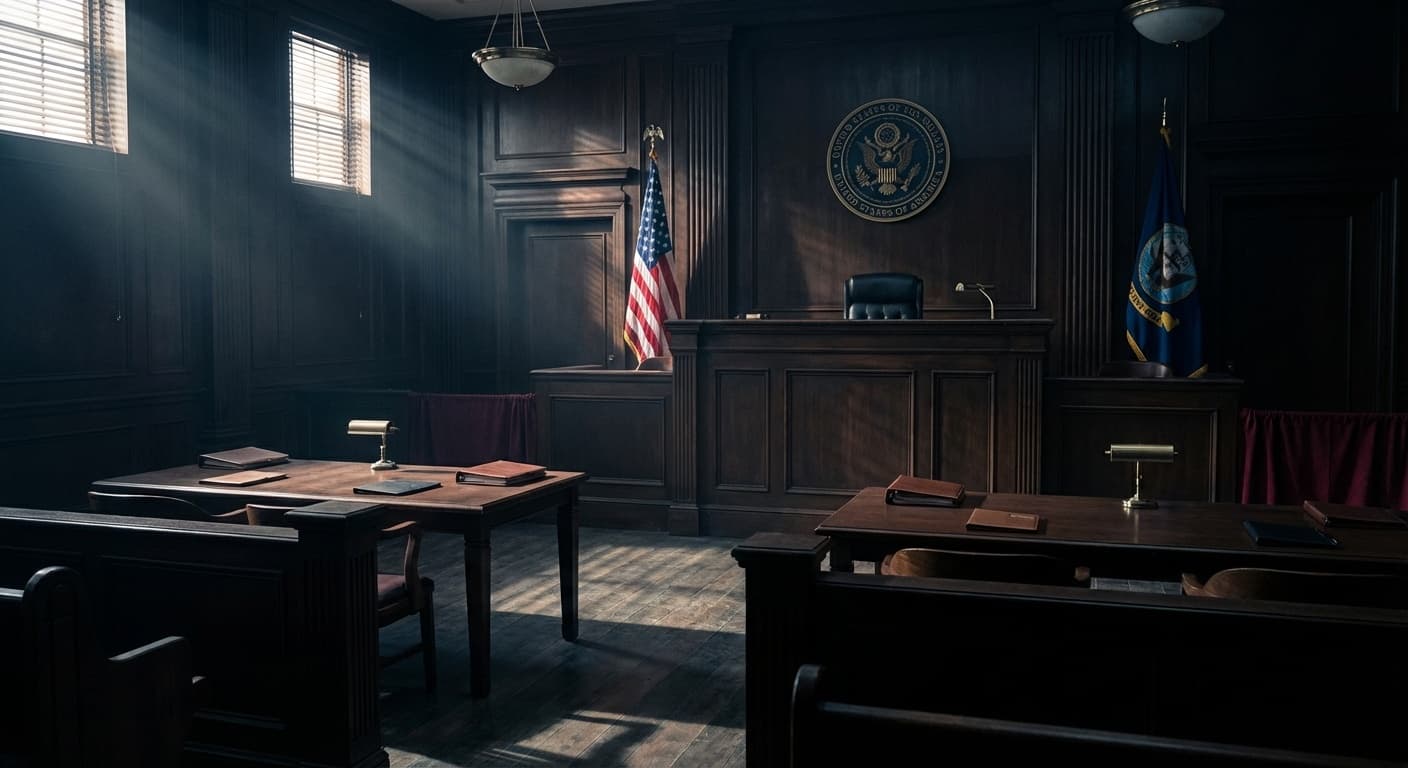
Court-Martial Defense Attorney.
A court-martial is a federal criminal trial under the Uniform Code of Military Justice. Unlike NJP or administrative separation, a court-martial conviction is a federal criminal conviction. It can carry confinement measured in years, a punitive discharge (Bad Conduct or Dishonorable), forfeiture of pay and allowances, reduction in rank, and consequences that follow a servicemember and veteran for life. If you received a military charge sheet, the 15-minute call is free.
Free 15-Min Call
Court-Martial Defense
Court-Martial Defense
When UCMJ charges are referred, who sits at the defense table matters. Matthew defends servicemembers at special and general courts-martial across the branches.
A court-martial is not a disciplinary action. It is a federal criminal trial. Conviction creates a federal criminal record that shows up in background checks and can disqualify the veteran from federal employment, security clearances, and certain professional licenses.
Need ongoing support?
“A court-martial conviction is a federal criminal record. Article 31 attaches earlier than Miranda. What you say before you have counsel is the hinge of most cases.”
Case record includes a MARSOC special operations prosecution where charges were dropped (covered by Task & Purpose) and an Army physician UCMJ defense (covered by CBS News).
The military justice system operates under the Uniform Code of Military Justice and the Manual for Courts-Martial. It has its own rules of evidence, its own pretrial procedures, and its own rights framework. Article 32 is the military's preliminary hearing, similar in purpose to a grand jury but not secret; defense counsel can actively participate, cross-examine witnesses, and challenge evidence.
Article 31 of the UCMJ requires rights advisement before any questioning by a person subject to the UCMJ who suspects the individual of an offense. These rights attach earlier than civilian Miranda rights. Any statement made without proper advisement may be suppressible. The single most important moment in many cases is the moment the servicemember decides whether to answer an investigator's questions or to invoke. That decision should be made with counsel, not alone in an interview room.
There are three types of courts-martial. A Summary Court-Martial is the least severe forum and a non-criminal proceeding, generally limited to enlisted members accused of minor offenses, with a single officer acting as judge and fact-finder and maximum punishment capped at 30 days confinement, forfeiture of two-thirds of one month's pay, reduction to the lowest pay grade, and restriction. A Special Court-Martial is an intermediate forum with a military judge presiding; potential punishment includes confinement up to twelve months, forfeiture of two-thirds pay per month for up to twelve months, reduction to E-1, and a Bad Conduct Discharge. A General Court-Martial is the highest military criminal forum and can try any offense under the UCMJ, including capital offenses; a Dishonorable Discharge is available for the most serious convictions.
Matthew has tried contested courts-martial. He has cross-examined government witnesses in high-stakes proceedings. He has argued complex evidentiary issues before military judges. And he has handled the pretrial motions practice, suppression of unlawfully obtained evidence, challenges to improper command influence, and contests to uncharged misconduct, that often decides whether the government's strongest evidence ever reaches the panel. Article 27(b) certified under the UCMJ; Ranked 3rd in Class, Naval Justice School.
Servicemembers have the right to retain civilian defense counsel at their own expense alongside appointed military defense counsel. Civilian counsel is not subject to military command authority, can dedicate more time to the case, and brings different trial experience to the table.
What You Need to Know
Read this before you do anything.
Article 31 rights attach earlier than Miranda
Article 31 of the UCMJ requires rights advisement before any questioning by a person subject to the UCMJ who suspects the individual of an offense. These protections attach earlier than civilian Miranda. A statement made without proper advisement can often be suppressed. Invoke before answering questions, and get counsel involved before any interview.
Three types of court-martial, three different exposures
Summary Court-Martial: enlisted-only, minor offenses, non-criminal proceedings. No right to military defense counsel at government expense. Capped at 30 days confinement. Special Court-Martial: military judge presides, up to twelve months confinement and a BCD possible. General Court-Martial: any UCMJ offense including capital cases; Dishonorable Discharge available. The forum determines the exposure, and the forum is often contestable.
Matthew accepts court-martial cases selectively
He takes a small number of courts-martial per quarter. When he accepts a case, he is not managing forty other files. He is building yours.
Trial experience is not optional
Cross-examination, motions practice, witness preparation, and closing argument are skills built over years of contested trial work. Matthew has tried cases and argued complex evidentiary issues in high-stakes military proceedings. He was named USMC Defense Counsel of the Year, National and Eastern Region (2021).
High-profile case experience
A MARSOC Marine prosecution covered by Task & Purpose: charges dropped. An Army physician UCMJ defense covered by CBS News. The selectivity enables the preparation depth every case deserves.
Pre-charge investigation is often the best window
Before charges are formally preferred, the command is still gathering facts. Counsel engaged at this stage can shape the investigation, contest adverse witness statements, and in some cases prevent charges from being referred at all.
Motions practice can eliminate the government's best evidence
Suppress unlawfully obtained evidence. Challenge improper command influence. Contest uncharged misconduct. Strong pretrial motions practice can remove the prosecution's strongest evidence before the panel ever sees it.
A conviction reaches past military service
A federal conviction under the UCMJ affects VA benefits eligibility, federal employment suitability, security clearance status, firearm rights under federal law, and civilian employment prospects. Certain convictions trigger sex offender registration. A Bad Conduct or Dishonorable Discharge from a court-martial cannot be upgraded through the DRB; the only path is BCMR or BCNR relief.

How It Works
The process, step by step.
Charges preferred and charge sheet review
When UCMJ charges are preferred, Matthew reviews the charge sheet and the available evidence immediately. Early analysis identifies the weakest points in the government's case and shapes the Article 32 strategy.
Article 32 preliminary hearing
Matthew uses the Article 32 aggressively: cross-examine government witnesses, challenge evidence, establish the defense record.
Discovery, investigation, and expert retention
Matthew obtains the complete government investigative file, interviews witnesses, and retains experts where the case requires.
Pre-trial motions
Suppress unlawfully obtained evidence. Challenge improper command influence. Contest uncharged misconduct. Strong pre-trial motions practice can eliminate the government's best evidence before trial.
Trial preparation and witness coordination
Matthew prepares every witness who will testify: character witnesses, expert witnesses, and the client.
Trial or negotiated resolution
Matthew tries cases at Camp Lejeune and nationwide. When a favorable resolution is available without trial, he pursues it. When trial is the answer, he is ready.
Post-trial and appeal
If the outcome is adverse, Matthew advises on post-trial motions and appellate options through the military appellate courts.
Why Matthew Thomas
A litigator. Not a paper-filer.
Former Marine Corps Judge Advocate. Active-duty defense counsel before private practice.
2x USMC Defense Counsel of the Year, nationally and for the Eastern Region in 2021.
Tried cases before military judges. Cross-examined witnesses. Argued motions. Matthew doesn't submit paperwork and hope. He litigates.
Represents clients nationwide across all branches and all case types.
“A court-martial conviction is a federal criminal record. Article 31 attaches earlier than Miranda. What you say before you have counsel is the hinge of most cases.”
Common Questions
Frequently Asked Questions
Have a question not covered here? The free 15-minute triage call is the fastest way to get a direct answer.
A court-martial is a federal criminal trial under the Uniform Code of Military Justice and the Manual for Courts-Martial. A military judge presides in Special and General Courts-Martial, and panel members (the military equivalent of a jury) can decide the facts if the accused elects a panel trial. Conviction is a federal criminal conviction.
Summary Court-Martial: enlisted-only, minor offenses, capped at 30 days confinement, no right to military defense counsel at government expense. Special Court-Martial: military judge presides, up to twelve months confinement and a Bad Conduct Discharge possible. General Court-Martial: the highest forum, can try any UCMJ offense including capital cases; Dishonorable Discharge available for the most serious convictions.
Article 31 of the UCMJ requires rights advisement before any questioning by a person subject to the UCMJ who suspects the individual of an offense. Article 31 attaches earlier than civilian Miranda and covers a broader set of situations. A statement made without proper Article 31 advisement may be suppressible. Invoke before answering questions, and talk to counsel before any interview.
An Article 32 is the military's preliminary hearing before charges can be referred to a General Court-Martial. It is similar in purpose to a civilian grand jury but it is not secret. Defense counsel can participate actively, cross-examine witnesses, and challenge evidence. The Article 32 is often the first real opportunity to build the defense case.
As early as possible. Pre-charge investigations, where the command and CID or NCIS or OSI are still gathering facts, are often the best moment to intervene. Waiting until charges are referred narrows the runway and can lock in damaging witness statements that did not need to exist.
Yes. Servicemembers have the right to retain civilian defense counsel at their own expense alongside appointed military defense counsel. Civilian counsel is not subject to military command authority and can dedicate time and resources to the case that appointed counsel often cannot.
A federal conviction under the UCMJ affects VA benefits eligibility, federal employment suitability, security clearance status, firearm rights under federal law, and civilian employment prospects. Certain convictions trigger sex offender registration. A Bad Conduct or Dishonorable Discharge cannot be upgraded through the Discharge Review Board; only the Board for Correction of Military Records or Board for Correction of Naval Records can grant limited relief.

Two Ways to Start
Your case deserves focused representation.
Matthew offers a free 15-minute call when you have an SOR, SIR, military charge sheet, or notification of separation. You explain the situation. He tells you whether it's a case he handles, what it involves, and what representation costs. No pitch.
All other matters · Paid