If your written response to a Statement of Reasons did not resolve your case, the next step is a hearing before a Defense Office of Hearings and Appeals (DOHA) administrative judge. DOHA handles clearance hearings for industry (contractor) applicants adjudicated through DCSA. Military and federal civilian (MIL/CIV) applicants typically go through a different process, with final authority resting with the Personnel Security Appeals Board (PSAB). Understanding which track your case is on is the starting point for any DOHA preparation.
DOHA hearings are not informal conversations. They follow rules of evidence and procedure. The government is represented by a Department Counsel who presents exhibits, calls witnesses, and argues that the security concerns in your case have not been mitigated. You have the right to present your own evidence, call witnesses, and testify on your own behalf.
Who goes through DOHA: contractors vs. federal employees
DOHA serves as the contested-case forum for DCSA clearance cases. Both industry (contractor) and MIL/CIV (active-duty military and federal civilian) cases may have a hearing before a DOHA administrative judge (AJ).
The key distinction is in the effect of the AJ's decision. In industry cases, the AJ issues a decision that is controlling unless appealed to the DOHA Appeal Board, which is the final administrative authority. In MIL/CIV cases, the AJ's opinion is advisory and viewed as a recommendation only. For MIL/CIV cases, the final decision is made by the Personnel Security Appeals Board (PSAB).
The arc of a DOHA hearing
Weeks before
Pre-hearing preparation
Review every government exhibit. Prepare your own exhibits and organize them clearly. Identify and prepare witnesses who can speak to specific mitigating conditions. Practice your testimony with your attorney. Understand the guidelines and mitigating conditions at issue.
Day of hearing
Opening statements
Both sides outline their positions. Department Counsel goes first, framing the government's security concerns. Your attorney presents your theory of mitigation and previews the evidence.
Day of hearing
Government's case-in-chief
Department Counsel presents documentary evidence and may call witnesses. In most clearance cases, the government relies primarily on documents: your SF-86, investigation reports, financial records, police reports.
Day of hearing
Your case
You present your evidence and testimony. This is where mitigation lives. Character witnesses, treatment records, financial rehabilitation documentation, and your own testimony explaining what happened and what has changed.
Day of hearing
Closing arguments
Both sides summarize their positions and argue how the evidence should be weighed under the Adjudicative Guidelines.
2-12 months after
Written decision
The administrative judge issues a written decision analyzing the evidence under the applicable guidelines and mitigating conditions. The decision either grants or denies your clearance.
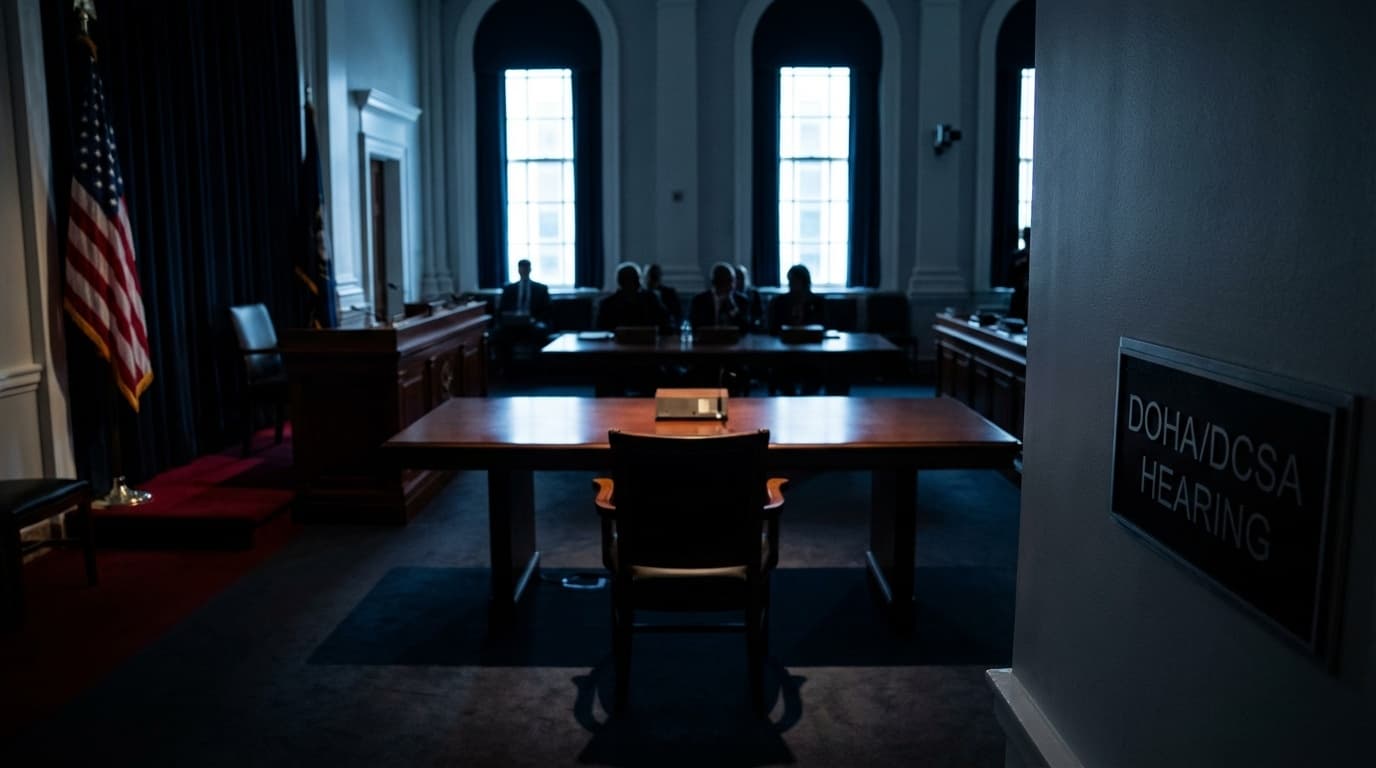
This is not a courtroom trial. But the stakes are the same.
A typical DOHA hearing runs two to four hours. The administrative judge manages the proceeding, asks questions, and evaluates credibility. There is no jury. The standard is whether it is clearly consistent with the interests of national security for the applicant to be granted a security clearance. The judge's written decision typically arrives within months of the hearing.
What to prepare before your hearing
- 1.Review every government exhibit
You will receive the government's proposed exhibits before the hearing. Read every page. Know what the government is going to argue and which facts it is relying on.
- 2.Prepare your own exhibits
Payment histories, counseling certificates, medical records, employment evaluations, awards, character letters. Organize them clearly and be prepared to explain how each one addresses a specific mitigating condition.
- 3.Identify and prepare witnesses
A supervisor who says 'he's a great employee' is helpful. A supervisor who says 'I am aware of the financial issues, and here is what I have observed him do to address them over the past 18 months' is far more effective.
- 4.Practice your testimony
You will likely testify. If you have not practiced articulating what happened, what you have done about it, and why the concern is mitigated, the hearing is not the place to figure it out.
- 5.Know the guidelines cold
Understand the specific adjudicative guidelines at issue, the security concerns they raise, and the mitigating conditions that apply. Every piece of evidence should connect to a specific mitigating factor.
What adjudicators are actually evaluating
DOHA judges apply the Adjudicative Guidelines for Determining Eligibility for Access to Classified Information. The judge is asking one question: Has this person demonstrated, through credible evidence, that the security concerns raised by the government have been mitigated? That question is not answered by emotion or general character. It is answered by specific evidence mapped to specific mitigating conditions.
“The hearing is not where you win or lose. The hearing is where you present the case you built in the weeks and months before. Preparation is the outcome.”
Common questions about DOHA hearings
Take Action
Facing a DOHA hearing or MIL/CIV clearance hearing?
If you received an SOR, the 15-minute call is free. The earlier you start preparing, the stronger your case. Matthew has appeared before DOHA administrative judges and handled MIL/CIV personnel security matters.
Book a Free 15-Min Call