Marijuana use, even in a state where it is fully legal, remains a security concern for federal clearance holders and applicants. Marijuana is still a Schedule I (pending reclassification to Schedule III) controlled substance under federal law, and the adjudicative guidelines that govern clearance decisions are federal, not state. State marijuana laws do not determine how DCSA, an Intelligence Community agency, or a military command evaluates a clearance or a UCMJ case.
That does not mean past marijuana use ends a clearance case on its own. It means the analysis is specific: recency, frequency, circumstances, and whether the applicant can demonstrate (through disclosure and through conduct since) that use has stopped and will not resume.
12 mo.
Commonly cited recency threshold
Adjudicators often treat marijuana use within the preceding 12 months as a significant concern under Guideline H. Use beyond 12 months can still be cited, but the mitigation case is typically stronger the further the use is from the present.
Does marijuana use disqualify you from a security clearance?
Under SEAD 4 Guideline H (Drug Involvement and Substance Misuse), adjudicators weigh both the disqualifying conditions and the mitigating conditions. The disqualifying conditions include recent use, a pattern of abuse, and failure to follow treatment recommendations. The mitigating conditions include the absence of recent use, completion of a substance abuse program, and a demonstrated intent to comply with legal standards going forward. Past use, handled well, is often mitigated.
Marijuana use scenarios: what raises concern vs. what supports mitigation
State marijuana laws and federal adjudication: a critical distinction
This is the most common mistake applicants make when disclosing marijuana use on the SF-86. They note that the use occurred in a legal-use state and assume that mitigates the concern. It does not. Adjudicators apply federal law and federal guidelines. The legality of the conduct at the state level is not a mitigating condition listed in SEAD 4 Guideline H.
What does work: acknowledging the use directly and completely, explaining the circumstances and timeline accurately, and demonstrating (through the passage of time and subsequent conduct) that use has ended and will not resume. The framing often matters as much as the facts.
CBD and security clearance: why it is different for military members
CBD products are prohibited for service members regardless of state law or product labeling. DoD policy and individual service policies prohibit use of hemp-derived products that can produce a positive drug test result, and compliance with that policy is not affected by whether the product is legal to purchase at a state level. A service member who uses CBD, and then tests positive, can face both a UCMJ Article 112a issue and a Guideline H concern on any subsequent clearance action.
For civilian applicants, CBD derived from hemp under 0.3% THC is generally not illegal federally, but the SF-86 asks about illegal drug use broadly, and certain full-spectrum CBD products contain enough THC to produce a positive test result during a background investigation. A positive drug test creates a Guideline H concern regardless of what caused it.
Marijuana and military service: UCMJ Article 112a
For service members, marijuana use is governed by UCMJ Article 112a, not state law. The UCMJ prohibits the wrongful use of controlled substances, and marijuana remains a controlled substance under federal law. A service member using marijuana while on leave in a legal-use state is still exposed to Article 112a prosecution, administrative separation, and clearance consequences. State legalization does not create a UCMJ defense.
For a service member, a positive drug test or an admission of marijuana use often triggers a combined Guideline H (drug involvement) and Guideline E (personal conduct and judgment) concern in any clearance context, because the use itself violated UCMJ Article 112a. That combination is often harder to mitigate than either concern on its own.
What adjudicators look at: recency, frequency, and circumstances
Past marijuana use that is remote in time, was not habitual, and has not recurred is among the more frequently mitigated fact patterns in clearance adjudication. DOHA case law in the DCSA context supports favorable outcomes when the facts support them. Recent use, regular use, or use after a clearance warning is handled differently, and the mitigation case requires substantially more.
Past marijuana use vs. current use: how the timeline matters
Applicants sometimes assume that an isolated episode three or four years ago, followed by years of abstinence and steady employment, is the same kind of case as continued use into the present. It is not. The system rewards time, and it rewards demonstrated cessation. The earlier the use stopped, and the more conduct since that is consistent with abstinence, the stronger the mitigation.
Disclosing marijuana use on the SF-86
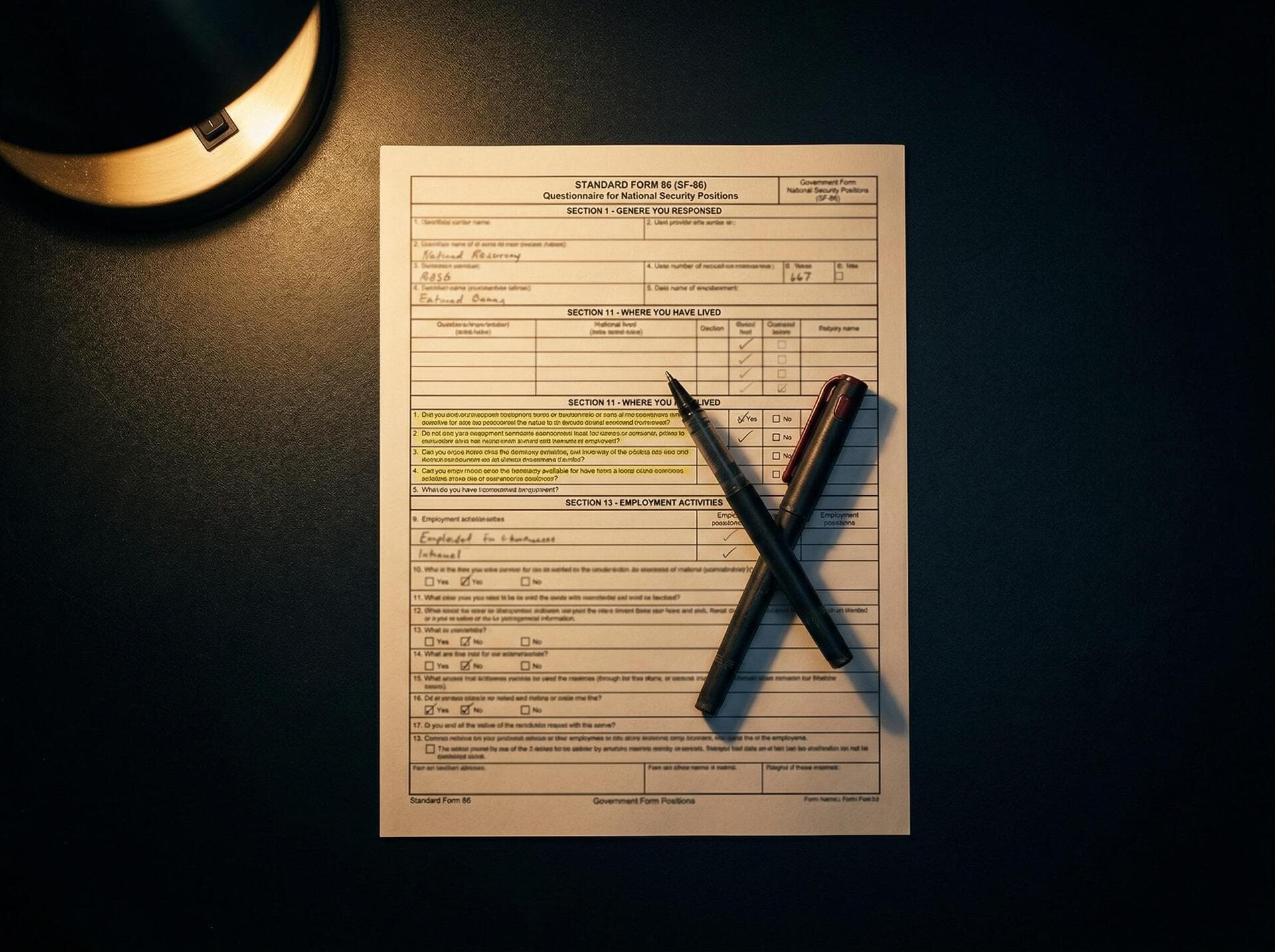
The SF-86 is 136 pages, and Section 23 covers illegal drug use within the past 7 years, drug-related counseling, treatment, and dependence. Answer the questions accurately. Under-disclosing creates a Guideline E (Personal Conduct) problem layered on top of the Guideline H problem. The Guideline E concern for deliberate omission is often harder to mitigate than the underlying drug use itself.
If you are unsure what to disclose, a paid SF-86 consultation before you file can change how the form lands. SF-86 consultations are paid advice, not a free call.
What about use before enlistment or before applying?
Marijuana use before military service or federal employment is still disclosable and still evaluated under Guideline H. Pre-service use that is remote in time, was not habitual, and was followed by years of military or government service is among the more successfully mitigated fact patterns in clearance adjudication. Adjudicators have seen this scenario many times.
“The question is rarely whether someone used marijuana. The question is whether they can demonstrate that use has stopped, that they understand why it matters for the clearance, and that the government can rely on them going forward. Disclosure plus cessation plus time tends to be the formula that works.”
Frequently asked questions about marijuana and security clearance
Take Action
Marijuana on your SF-86 or in your SOR?
If you received an SOR or SIR, the 15-minute call is free. If you are filling out an SF-86 with marijuana use to disclose, that is a paid 60-minute consultation.
Book a Free 15-Min Call